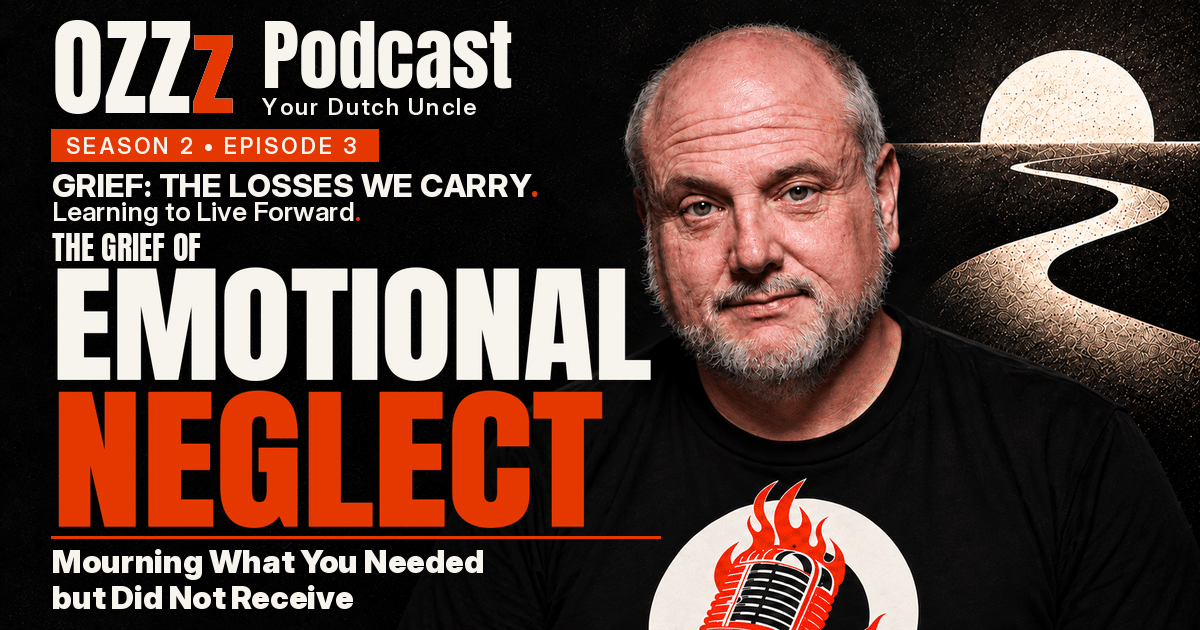
Episode Summary: In Season 2, Episode 3 of the OZZz Podcast, Hoomes explores the grief of emotional neglect — what can happen when affection, encouragement, emotional safety, reassurance, or simply feeling seen and heard were missing from childhood or important adult relationships. Drawing from his own life, his years as a teacher, and experiences that changed how he understands emotional connection, Hoomes talks about independence, relationships, boundaries, therapy, faith, self-validation, and learning to live forward when someone may never become the person you needed them to be.
The Grief of Emotional Neglect: Mourning What You Needed but Did Not Receive
Season 2, Episode 3
Sometimes grief begins with losing someone or something we once had.
Other times, grief begins much later, when we recognize something important was missing all along.
That is the conversation at the center of The Grief of Emotional Neglect: Mourning What You Needed but Did Not Receive.
Listen to Episode 3 and join Hoomes for the full conversation.
What Is Emotional Neglect?
What Is Emotional Neglect?
Emotional neglect can happen when important emotional needs are repeatedly missed, dismissed, overlooked, or unsupported.
It does not always mean someone intentionally caused harm.
A child may have food, clothing, a home, education, and parents or caregivers who genuinely love them. Those same adults may be exhausted, overwhelmed, working several jobs, struggling with their own problems, or simply unfamiliar with the kind of emotional support the child needs.
Practical care matters.
Emotional presence matters too.
As Hoomes puts it in the episode, a person can be loved while still recognizing that something emotional was missing.
When You Finally Have Words for What Was Missing
One reason emotional neglect can be difficult to recognize is that children do not always have language for what they are experiencing.
Hoomes talks about this from his own life.
When he was 15, his parents divorced and the family dynamics he had known changed. He knew something felt different, but he did not yet have the language to describe what was happening emotionally.
Years later, he could look back with a different understanding.
That experience raises an important question:
How do you name something you did not know you were missing?
Sometimes recognition comes after meeting other people, seeing other families, entering relationships, going to therapy, becoming a parent, or simply gaining enough life experience to look backward differently.
You may see someone receive affection freely and realize you wanted that.
You may hear someone being told, “I'm proud of you,” and recognize how much you needed those words.
You may experience emotional safety for the first time and realize how unfamiliar it feels.
Recognition can bring sadness, anger, confusion, and even relief.
Now there are words for something that may have been carried quietly for years.
When Being “Strong” Becomes a Survival Skill
When Being “Strong” Becomes a Survival Skill
Some children learn very early not to ask for help.
If speaking up repeatedly changes nothing, they may stop speaking up.
If comfort rarely comes, they may stop expecting comfort.
Eventually, that child can become the adult everyone describes as strong, independent, dependable, or the person who always takes care of everybody else.
Hoomes understands that role personally.
He talks about becoming “the big brother,” the person who gave and supported others.
But knowing how to give does not automatically mean someone knows how to receive.
Healthy affection can feel unfamiliar.
Help can create suspicion.
Someone saying, “You don't have to do everything by yourself,” can be comforting and frightening at the same time.
Sometimes independence is strength.
Sometimes it is also protection.
Children Still Need Us to Show Up
Children Still Need Us to Show Up
Hoomes brings his years as a teacher into this episode.
He remembers seeing parents work hard to provide financially for their children, often while carrying significant pressures themselves.
He also noticed how easily emotional presence can get lost in everything adults are trying to manage.
Showing up matters.
Listening matters.
Affection matters.
Saying “I'm proud of you” matters.
And those needs do not disappear when a child becomes a teenager.
A teenager may insist that it does not matter whether a parent attends the game, performance, conference, or event.
Hoomes has a different perspective after years in the classroom:
They still notice who showed up.
Grieving the Parent or Childhood You Needed
One of the more difficult realizations in emotional neglect is that gratitude and grief can exist together.
You can appreciate what a parent provided and still recognize what they could not provide emotionally.
You can know somebody loved you and still acknowledge that you needed something they did not know how to give.
You can also recognize that their intention and your experience were different.
That distinction matters throughout this episode.
Someone may genuinely believe they did the best they could.
Their best may still have left something missing for you.
Recognizing that difference does not automatically require blame.
It does require honesty.
Emotional Neglect Can Happen in Adult Relationships Too
Emotional neglect is not limited to childhood.
Someone can feel deeply alone while sharing a home, responsibilities, routines, and years of life with another person.
The bills may be paid.
The household may function.
From the outside, everything may appear fine.
And someone inside the relationship may still be wondering:
Do you listen to me?
Do you appreciate me?
Do you notice me?
Are you emotionally present?
Hoomes returns repeatedly to communication because assumptions can create distance.
Believing someone “should know” they are loved is not always the same as expressing love in a way the other person can recognize and receive.
His grandmother helped teach him that lesson.
Hoomes believed his actions communicated appreciation. His grandmother experienced those actions differently.
That realization helped shape something he does intentionally now: telling people directly that he appreciates them, believes in them, and is glad they are there.
Healing Cannot Depend Entirely on Someone Else
What happens when someone refuses to acknowledge your experience?
Maybe they do not remember it the same way.
Maybe they insist nothing was wrong.
Maybe they believe you had everything you needed.
Hoomes makes a distinction that also connects Episode 3 back to the previous conversation about ambiguous loss:
Your healing cannot always depend on somebody else agreeing with you.
That may mean learning to identify your needs.
Setting boundaries.
Finding healthier relationships.
Seeking counseling or therapy.
Returning to faith.
Accepting support from friends or community.
Learning to recognize healthy love when it appears.
And sometimes accepting that a person may never become who you hoped they would become.
Living forward does not require pretending the past never happened.
It means deciding the past will not determine everything about the future.
Reflection Question
Have you ever grieved something you needed emotionally but never received?
Maybe it was affection.
Encouragement.
Protection.
Reassurance.
Attention.
Emotional safety.
Acceptance.
A parent who listened.
A partner who understood.
Or someone who simply said:
“I see you.”
What did you need?
When did you realize you needed it?
And what have you learned since then?
Season Two Recommended Reading
Throughout Season 2, Hoomes is recommending two books as resources for thinking more deeply about grief:
Grief Is a Journey: Finding Your Path Through Loss by Kenneth J. Doka, PhD
This book explores how differently people experience grief and recognizes forms of loss that other people do not always understand or acknowledge.
The Wild Edge of Sorrow: Rituals of Renewal and the Sacred Work of Grief by Francis Weller
This book takes a broader look at sorrow, meaning, relationships, life changes, and the grief people may carry privately.
These books are resources, not instructions. There is no single correct way to experience grief.
Amazon Affiliate links are provided above. OZZz Podcast may receive a small commission from qualifying purchases at no additional cost to you.
Frequently Asked Questions
Can emotional neglect happen even when a parent loves their child?
Yes. Emotional needs can be missed even when love is present. A caregiver may be overwhelmed, unavailable, unsure how to express affection, or repeating patterns from their own upbringing. Intent and experience are not always the same.
Can someone grieve something they never had?
Yes. A person may grieve affection, encouragement, emotional safety, parental connection, or a childhood experience they recognize later that they needed but did not receive.
Why can emotional neglect be difficult to recognize?
There may be no single obvious event. Practical needs may have been met, and the person may not recognize what was missing until they experience healthier relationships or gain language for their emotional needs later in life.
Can emotional neglect affect adult relationships?
It can. Hoomes discusses how unmet emotional needs may show up as extreme independence, discomfort receiving affection, difficulty asking for help, people pleasing, trouble communicating needs, or feeling emotionally alone in a relationship.
Do I have to reconcile with someone in order to heal?
Hoomes' perspective in this episode is no. Reconciliation and forgiveness are not requirements for living forward. Boundaries and distance may sometimes be part of protecting your emotional well-being.
Ask OZZz
Did this episode bring up a question about childhood, family, relationships, emotional needs, boundaries, grief, or something you are still trying to understand?
Visit the Ask OZZz section of the website to submit your question or share what is on your mind.
Your question may be something another listener has been carrying quietly too.
Continue the Conversation
The podcast is only one part of the OZZz community.
Through the website, you can:
- Submit an Ask OZZz question
- Learn about the Featured Artist Spotlight
- Explore OZZz brand apparel
- Discover podcast sponsorship opportunities
- Join the monthly newsletter
Follow Season 2 as Hoomes continues exploring the many forms of grief people carry.
Final Thoughts
Sometimes we grieve not only what we lost, but what we never had.
Recognizing what was missing does not require pretending there was no love.
It does not require rewriting every memory.
It can simply mean becoming honest about what you needed, understanding yourself more clearly, and deciding what healthier relationships can look like now.
That is part of living forward.
Know you have value.
Know you have worth.
Know you are loved.
And remember:
I love you more than I love my luggage.
Coming Next Week
Episode 4
Pregnancy, Fertility, and Parenthood
Grieving the Family You Imagined
Next week, Hoomes opens a compassionate conversation about reproductive experiences, parenthood expectations, and the different ways people may experience grief around the family or future they once imagined.
The episode will explore pregnancy loss, infertility, fertility complications, not being able to have children, choosing not to have children and later questioning that decision, wanting children when circumstances never came together, partners experiencing the same event differently, and the complicated emotions that can accompany these experiences.
The conversation also makes room for something important: nobody else gets to decide how another person is supposed to feel.
Reflection Question:
Have you ever had to grieve a version of family or parenthood you once imagined for yourself?
Because sometimes, some of the deepest grief is connected to a future we could already see in our minds.
About the OZZz Podcast
Hosted by Hoomes OZZz, “Your Dutch Uncle,” the OZZz Podcast features Real Conversations. Honest Perspective. about family, relationships, grief, healing, personal growth, community, and everyday life.
Season 2, Grief: The Losses We Carry. Learning to Live Forward, explores the many forms grief can take and the experiences people often carry quietly.
Important Note
This episode includes Hoomes discussing suicidal thoughts he experienced when he was 15.
The OZZz Podcast is intended for conversation, reflection, education, and entertainment. It is not a substitute for qualified medical or mental-health care.
If you are in immediate danger or thinking about harming yourself, please seek immediate help where you are.