Episode Summary: In Season 2, Episode 5 of the OZZz Podcast, Hoomes explores the grief that can sometimes accompany children growing up, leaving home, and becoming independent adults. He talks about empty-nest emotions, changing family traditions, parents being needed differently, identity after active parenting, mothers and fathers experiencing transition in different ways, marriage after children leave home, and the challenge of moving from managing a child's life to building an adult-to-adult relationship. Hoomes also discusses boundaries, adult children moving back home, expectations around phone calls and visits, supporting without controlling, and what his years as a teacher taught him about watching young people grow into responsible adults and parents themselves. Throughout the episode, he reminds listeners that sadness and pride are not opposites and that missing an earlier season of family life does not mean rejecting the person your child has become.
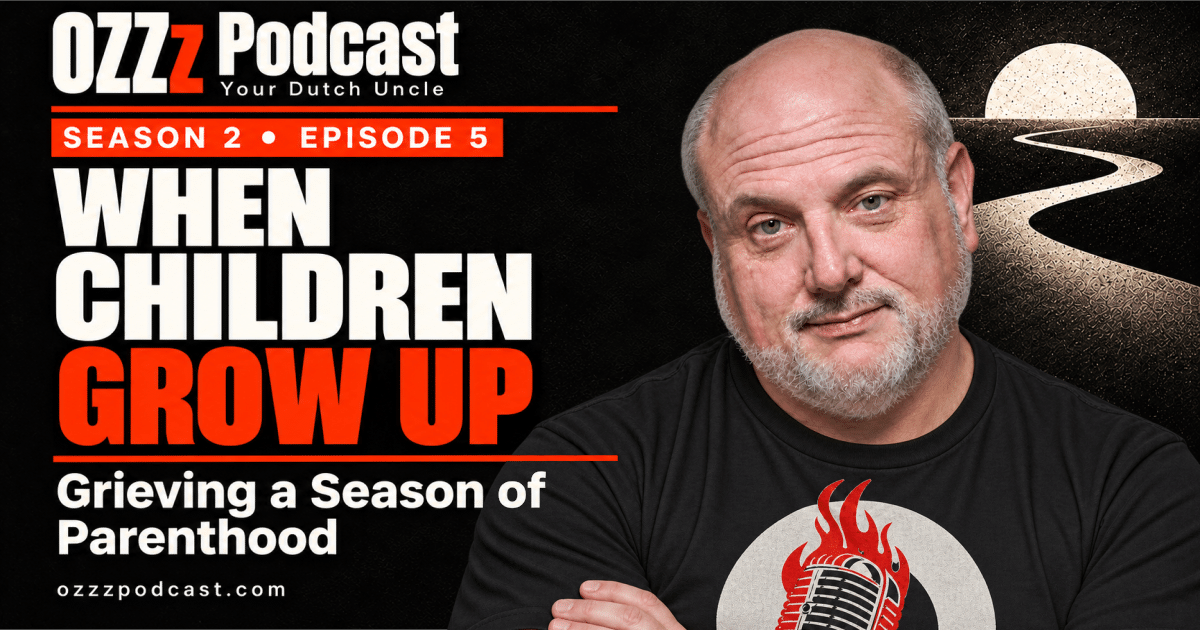
When Children Grow Up: Grieving a Season of Parenthood
Season 2, Episode 5
Parents spend years helping children grow into independent adults.
Then one day, that independence actually arrives.
The house may become quieter. The routines change. Family traditions shift. The child who once needed help with almost everything begins making decisions, building relationships, pursuing a career, and creating a life of their own.
And sometimes pride is not the only emotion that comes with it.
That is the conversation at the center of When Children Grow Up: Grieving a Season of Parenthood.
Listen to Episode 5 and join Hoomes for the full conversation.
When a Season Changes
Children growing up is usually something parents have spent years preparing for.
They teach.
Protect.
Encourage.
Guide.
And eventually, the child begins creating a life of their own.
But even positive change can carry emotion.
Sometimes what a parent misses is not the child themselves, but a season of everyday life that cannot happen in quite the same way again.
In the episode, Hoomes talks about what it means to recognize that change without treating independence as rejection or healthy growth as something tragic.
When Being Needed Starts to Look Different
Parenthood does not automatically end when a child becomes an adult.
But the relationship may have to change.
There may be new questions around communication, advice, boundaries, family traditions, adult independence, and how involved a parent should be in decisions their grown child now makes for themselves.
Hoomes takes a closer look at that transition and what it can mean for both generations.
When does guidance become control?
How do parents remain supportive without trying to manage an adult child's life?
And how does a relationship grow when both the parent and child are now adults?
Those questions are part of the deeper conversation in Episode 5.
Who Are You Beyond Active Parenting?
When parenting has shaped everyday life for years, a quieter home can bring another question:
Who am I now?
For some parents and caregivers, this season may create space to reconnect with interests, relationships, dreams, purpose, or parts of themselves that received less attention while raising children.
Hoomes does not treat that transition as a simple loss.
He also asks listeners to consider what might be beginning.
As he says in the episode:
“The nest may be empty, but your life does not have to be.”
Reflection Question
What season of parenthood or family life have you had the hardest time letting go of?
Maybe it was childhood.
Graduation.
College.
A child moving away.
Marriage.
The first holiday when everyone could not be together.
Or simply realizing that family life does not look the way it once did.
What do you miss?
What changed?
And what have you learned about loving people as they grow into lives of their own?
Season Two Recommended Reading
Throughout Season 2, Hoomes recommends two resources for listeners who want to continue thinking about grief, change, and the different kinds of loss people carry:
Grief Is a Journey: Finding Your Path Through Loss by Kenneth J. Doka, PhD
This book explores how differently people experience grief and recognizes forms of loss that other people do not always understand or acknowledge.
The Wild Edge of Sorrow: Rituals of Renewal and the Sacred Work of Grief by Francis Weller
This book takes a broader look at sorrow, meaning, relationships, life changes, and the grief people may carry privately.
These books are offered as resources, not instructions for how anyone is supposed to grieve.
Take what helps.
Leave what does not.
Amazon Affiliate links are provided above. OZZz Podcast may receive a small commission from qualifying purchases at no additional cost to you.
Frequently Asked Questions
Can parents grieve when their children grow up?
Some parents and caregivers experience sadness, loneliness, identity changes, or a sense of loss as children become more independent and family routines change. Others may feel pride, relief, excitement, or a mixture of emotions. There is no single response that applies to everyone.
What does empty-nest grief mean?
Empty-nest grief can describe feelings that sometimes arise when children leave home and parents adjust to a different daily life. The change may involve routines, companionship, family traditions, identity, or the experience of being needed differently.
Does the parent-child relationship end when children become adults?
No. The relationship can continue, but it often changes. Adult children make more of their own decisions, establish boundaries, and build independent lives. Parents and adult children may need to develop new ways of communicating, supporting one another, and staying connected.
Ask OZZz
Has your relationship with your children changed as they became adults?
Are you adjusting to an empty nest?
Are you trying to support an adult child without controlling their choices?
Or are you the adult child trying to build a different relationship with your parents?
Send your question to Hoomes through Ask OZZz
Your question may be the same one someone else has been carrying quietly.
Continue the Conversation
The podcast is only one part of the OZZz community.
Through the website, you can:
- Submit an Ask OZZz question
- Learn about the Featured Artist Spotlight
- Explore OZZz brand apparel
- Discover podcast sponsorship opportunities
- Join the monthly newsletter
Follow Season 2 as Hoomes continues exploring the many forms of grief people carry.
Final Thoughts
Children growing up does not necessarily mean something has gone wrong.
Often, their independence is part of what parents and caregivers spent years preparing them for.
But that does not mean every part of the transition feels easy.
Sometimes we miss a season because it mattered.
Sometimes we miss who we were during that season.
And sometimes learning to live forward means allowing a relationship to become something new instead of trying to hold it in the past.
As Hoomes reminds listeners in Episode 5:
“Sometimes love means celebrating the very independence that makes us miss what used to be.”
Coming Next Week
Episode 6
Grief Inside a Relationship
Intimacy, Betrayal, and Emotional Distance
Next week, Hoomes explores the grief that can exist inside a relationship even when the relationship has not officially ended.
Reflection Question:
Have you ever grieved something inside a relationship that technically still existed?
Closing Thought:
A relationship does not have to end for someone to experience loss inside it.
About the OZZz Podcast
Hosted by Hoomes OZZz, “Your Dutch Uncle,” the OZZz Podcast features Real Conversations. Honest Perspective. about family, relationships, grief, healing, personal growth, community, and everyday life.
Season 2, Grief: The Losses We Carry. Learning to Live Forward, explores the many forms grief can take and the experiences people often carry quietly.
Important Note
The OZZz Podcast is intended for conversation, reflection, education, and entertainment. It is not a substitute for qualified medical or mental-health care.
Family transitions, grief, loneliness, stress, relationship changes, and identity shifts can affect people differently. If emotional or physical concerns become persistent, worsen, or begin interfering with everyday life, consider reaching out to an appropriate qualified professional who can work with your individual situation.