Episode Summary: In the Season 1 finale of the OZZz Podcast, Hoomes OZZz looks back on the conversations that shaped the sibling rivalry season and reflects on what those discussions brought up in his own life. The episode explores different childhood experiences, family roles, favoritism, boundaries, forgiveness, reconciliation, adult sibling conflict, and the ways old family patterns can continue into adulthood. Hoomes also reflects on his sisters, therapy, his grandmother, myasthenia gravis, and what this season taught him about accountability, healing, and seeing family relationships from a different perspective.
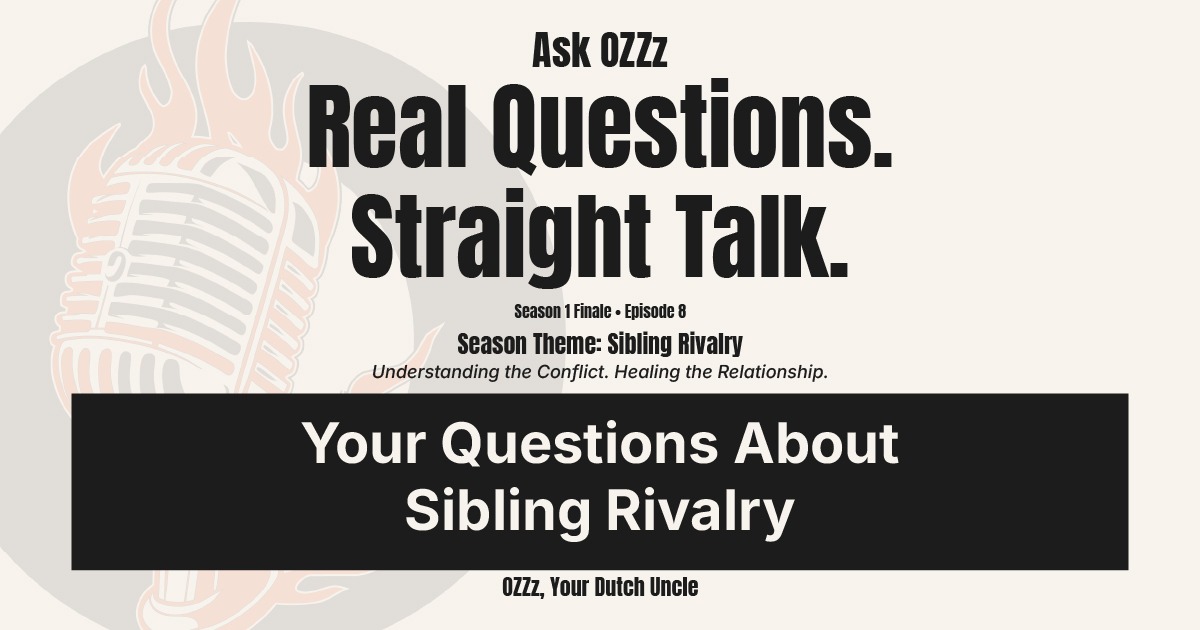
Ask OZZz: Your Questions About Sibling Rivalry
Season 1 Finale, Episode 8
Season 1 began with a simple question:
What is sibling rivalry?
But the deeper the conversation went, the clearer it became that sibling rivalry is about much more than brothers and sisters arguing as children.
It can be shaped by comparison, birth order, favoritism, family roles, parent influence, unresolved hurt, financial differences, caregiving, estrangement, and the very different ways siblings can experience the same family.
In the finale, Hoomes looks back at those themes and reflects on how the season changed the way he sees parts of his own family story.
Siblings Can Grow Up in the Same Family and Experience It Differently
One of the strongest themes throughout Season 1 is that siblings can share the same parents and still experience childhood very differently.
Age, family circumstances, divorce, finances, expectations, responsibilities, and individual relationships can all shape how each child remembers home.
In this episode, Hoomes reflects on how that idea became personal for him.
The season pushed him to reconsider some of the experiences he and his sisters carried into adulthood and recognize that sharing a family does not mean sharing the exact same story.
That realization can be difficult for adult siblings.
One person may remember a parent as loving and supportive.
Another may remember feeling overlooked.
One sibling may remember stability.
Another may remember conflict.
Both experiences may be real.
Understanding that difference does not automatically resolve family tension, but it can create room for a more honest conversation.
Accountability Without Taking Responsibility for Everything
The finale also explores what accountability can look like in complicated family relationships.
Hoomes reflects on his own role in past conflict and the importance of acknowledging the things that belong to him.
That does not mean accepting responsibility for everything that went wrong.
It means being willing to ask:
What part of this was mine?
For many adult siblings, that can be a difficult question.
It is often easier to focus entirely on what someone else said, did, or failed to do.
But healing sometimes requires looking inward too.
An apology may not repair the relationship.
The other person may not respond the way you hope.
But taking responsibility for your own behavior can still be part of personal growth.
Forgiveness and Reconciliation Are Not the Same Thing
One of the most important ideas repeated throughout Season 1 is this:
Forgiveness does not automatically mean reconciliation.
Forgiving someone does not necessarily mean returning the relationship to what it used to be.
It does not mean pretending the hurt never happened.
It does not mean instantly restoring trust.
And it does not mean giving someone unlimited access to your life.
Sometimes reconciliation is possible.
Sometimes a relationship can be rebuilt in a healthier way.
And sometimes distance remains the healthiest choice.
In the finale, Hoomes reflects on the idea that healing may look different for every family.
For one person, healing may mean reconnecting.
For another, it may mean creating stronger boundaries.
For someone else, it may simply mean carrying less anger than they did before.
When Old Family Roles Follow Us Into Adulthood
Families often create roles without realizing it.
The responsible one.
The difficult one.
The favorite.
The peacemaker.
The successful one.
The athletic one.
The smart one.
The black sheep.
Those labels may begin in childhood, but they can follow siblings for decades.
One of the questions Season 1 raises is whether adult siblings are still responding to who each other used to be.
People change.
Life changes them.
Careers, relationships, parenthood, illness, faith, loss, success, failure, and time all shape who someone becomes.
The sibling you remember from childhood may no longer be the same person today.
And you may not be the same person they remember either.
Real Questions. Straight Talk.
The Season 1 finale also looks at several real family situations shared publicly online.
Rather than trying to solve every family's problems, Hoomes uses these questions and situations as conversation starters.
They touch on:
- Favoritism between siblings
- Financial differences within families
- Adult sibling jealousy
- Parent expectations
- Family boundaries
- Forced sibling closeness
- Competition between children
- Estrangement and reconciliation
Each family looks different.
But many of the same questions continue appearing.
Why did my sibling seem to get more?
Why do we remember childhood differently?
Do I need to forgive?
Should I reconcile?
When is a boundary necessary?
Can I love my sibling and still need distance?
Those are exactly the kinds of complicated questions this season set out to explore.
Parents Cannot Force Sibling Closeness
Parents naturally want their children to get along.
Many parents hope their children will grow into adults who remain close for life.
But closeness cannot always be manufactured.
Parents can teach respect.
They can model healthy communication.
They can teach children how to disagree without cruelty.
They can encourage connection.
But they cannot force two people to become best friends simply because they share parents.
Season 1 repeatedly returns to the importance of allowing siblings to become individuals rather than constantly comparing them or forcing them into roles.
Sometimes the healthiest thing parents can do is create room for each child to become who they are.
Boundaries Can Reveal What Was Already There
Another theme in the finale is the role boundaries play in family relationships.
Sometimes people assume a boundary creates conflict.
But in some families, the conflict was already present.
The boundary simply exposed it.
A family member who has always said yes may suddenly say no.
A sibling may decide certain behavior is no longer acceptable.
Someone may reduce contact.
Another person may choose not to discuss certain subjects anymore.
That change can create tension.
But tension does not automatically mean the boundary is wrong.
Sometimes boundaries make relationships healthier.
Sometimes they reveal that a relationship depended on one person always giving in.
Adult Sibling Relationships Can Be Complicated
The finale does not offer a simple formula for repairing every sibling relationship.
There isn't one.
Some siblings reconnect.
Some remain distant.
Some learn how to communicate differently.
Some forgive without rebuilding the relationship.
Some decide that limited contact is healthiest.
And some are still figuring out what they want.
What matters is understanding that family relationships can be complicated without automatically being hopeless.
There is room for growth even when the outcome does not look the way everyone expected.
What Parents Can Take Away From Season 1
Throughout the season, several lessons for parents continue to surface.
Parents can help reduce unhealthy sibling rivalry by:
- Avoiding unnecessary comparisons
- Celebrating each child's individuality
- Listening when children describe different experiences
- Avoiding permanent labels
- Teaching healthy conflict resolution
- Modeling apologies and accountability
- Avoiding favoritism when possible
- Not making one child responsible for another child's emotions
- Recognizing when normal sibling conflict becomes harmful
One especially important idea is remembering that parental intention and a child's experience are not always the same thing.
A parent may not have intended to show favoritism.
A child may still have experienced the situation that way.
Listening does not automatically mean agreeing with every memory.
But listening can create understanding.
What Adult Siblings Can Take Away From Season 1
Adult siblings have responsibilities too.
They may need to reconsider old assumptions.
They may need to stop responding to outdated family roles.
They may need to acknowledge hurt.
They may need to apologize.
They may need to establish boundaries.
And sometimes they may need to accept that the relationship cannot be forced.
One of Hoomes' strongest reminders in the finale is:
Loving somebody does not mean unlimited access.
That does not mean relationships should be discarded casually.
It means love, trust, access, forgiveness, and reconciliation are not all the same thing.
Reflection Question
Hoomes closes Season 1 with one final question:
What has this season taught you about your own family relationships?
Did you recognize a pattern?
Do you understand one of your siblings differently?
Do you see your parents differently?
Are you still carrying an old family role?
Do you need to apologize?
Do you need to forgive?
Do you need a stronger boundary?
Are you waiting for something from another person that may never come?
And most importantly:
What are you going to do with what you learned?
Season One Recommended Reading
Throughout Season One, OZZz recommended two books for listeners who want to continue exploring boundaries and sibling relationships:
Boundaries by Dr. Henry Cloud and Dr. John Townsend
A practical guide to developing healthy boundaries while maintaining loving relationships.
Adult Sibling Relationships by Geoffrey L. Greif and Michael E. Woolley
An insightful exploration of how sibling relationships continue changing throughout adulthood and how those relationships can become healthier over time.
Amazon Affiliate links are provided above. OZZz Podcast may receive a small commission from qualifying purchases at no additional cost to you.
Frequently Asked Questions
Can sibling rivalry continue into adulthood?
Yes. Childhood comparison, favoritism, family roles, resentment, money, caregiving, and unresolved conflict can continue affecting sibling relationships long after childhood ends.
Why can siblings remember childhood so differently?
Siblings may share the same parents but experience different family circumstances based on age, birth order, personality, finances, divorce, responsibilities, parenting changes, and individual relationships.
Does forgiveness mean siblings have to reconcile?
No. Forgiveness and reconciliation are different. Someone can forgive while still maintaining healthy boundaries or distance.
Can siblings love each other without being close?
Yes. Some adult siblings care about one another while deciding that limited contact or emotional distance is healthier for them.
Can parents force siblings to become close?
Parents can encourage respect and healthy communication, but emotional closeness cannot be guaranteed or forced.
Can boundaries help family relationships?
Yes. Healthy boundaries can clarify expectations, reduce repeated conflict, and protect emotional well-being.
Ask OZZz
Season 1 may be complete, but the conversation is not.
Do you have a question about family, relationships, boundaries, communication, growth, or life?
Visit the Ask OZZz and send Hoomes your question.
He may not have every answer.
But you can expect an honest perspective.
Continue the Conversation
The podcast is only one part of the OZZz community.
Through the website, you can:
- Submit an Ask OZZz question
- Learn about the Featured Artist Spotlight
- Explore OZZz brand apparel
- Discover podcast sponsorship opportunities
- Join the monthly newsletter
The newsletter is one of the best ways to stay connected during the break and receive updates as OZZz prepares for what comes next.
Final Thoughts
Season 1 began with sibling rivalry.
But the conversation grew into something larger.
It became a conversation about childhood, family roles, parents, identity, boundaries, forgiveness, estrangement, accountability, and growth.
The season does not end by pretending every relationship can be fixed.
Instead, it leaves listeners with something more realistic:
Every family has a story.
Every relationship has the potential for growth.
And sometimes that growth happens between two people.
Sometimes it happens within one person.
Coming Week
The OZZz Podcast is taking a short seasonal break.
Season 2 launches Wednesday, October 7, 2026.
The next topic remains a surprise.
Until then, catch up on Season 1, share an episode with someone who may need it, and stay connected through the OZZz newsletter.
New season.
New conversation.
Same Dutch Uncle.
About the OZZz Podcast
Hosted by Hoomes OZZz, Your Dutch Uncle, the OZZz Podcast features Real Conversations. Honest Perspective. about family, relationships, healing, communication, personal growth, and the complicated parts of life people do not always know how to talk about.
Each season explores one central topic through connected conversations designed to encourage reflection, support healthier relationships, and remind listeners that understanding often begins with simply being willing to have an honest conversation.
Season One explores:
Sibling Rivalry: Understanding the Conflict. Healing the Relationship.