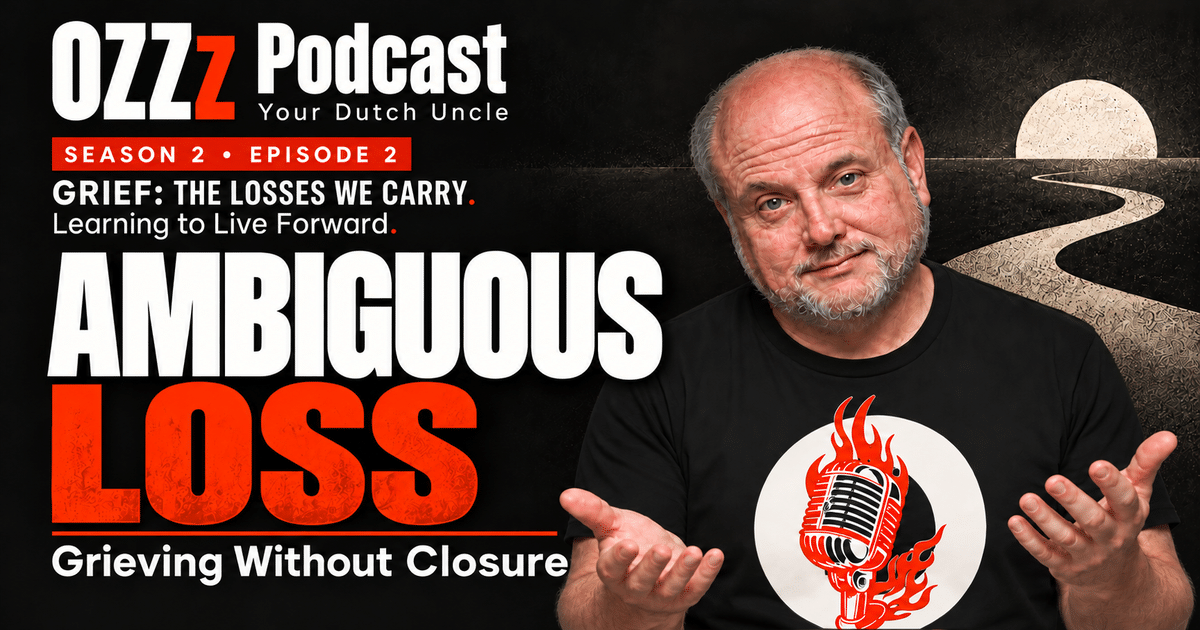
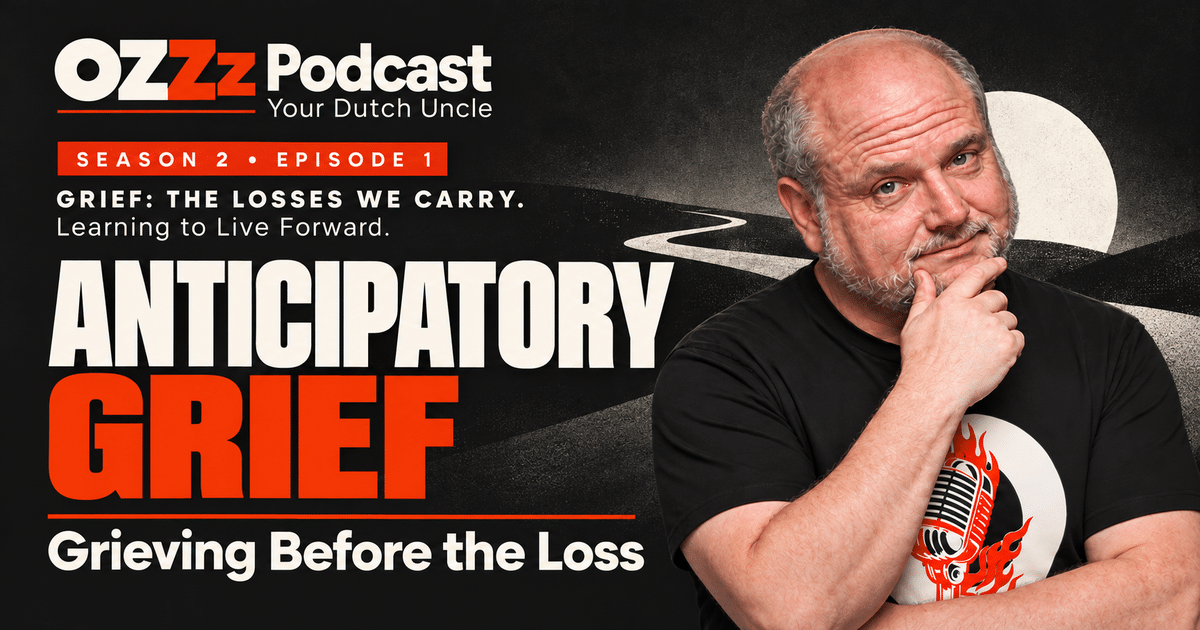
Episode Summary: In Season 2, Episode 1 of the OZZz Podcast, Hoomes OZZz opens the season with anticipatory grief, the grief that can begin before a loss has fully happened. The episode explores aging parents, serious illness, caregiving, hospice, children leaving home, changing relationships, uncertainty, relief, faith, and the emotional strain of knowing life may be changing before you are ready for it. Hoomes also reflects on his grandmother, his diagnosis with myasthenia gravis, the pressure to “stay strong,” why caregivers need support, and why he believes people should receive their flowers while they are still here to enjoy them.
Anticipatory Grief: Grieving Before the Loss
Season 2, Episode 1
Most people hear the word grief and think about what happens after someone dies.
But grief can begin much earlier.
Sometimes it starts when a parent stops driving.
When a loved one receives a diagnosis.
When someone begins losing strength, memory, or independence.
When a child leaves home.
When a relationship changes.
Or when the future you expected suddenly becomes uncertain.
In the Season 2 premiere of the OZZz Podcast, Hoomes OZZz, Your Dutch Uncle, begins with a question many people may have experienced without knowing there was a name for it:
What happens when you begin grieving something before it is actually gone?
That is anticipatory grief.
And as Hoomes makes clear throughout the episode, it does not look the same for everyone.
Listen to Season 2, Episode 1: Anticipatory Grief — Grieving Before the Loss
Grief Does Not Always Begin With Death
Anticipatory grief often appears when we recognize that something important is changing.
The person may still be here.
The relationship may still exist.
The job may still be yours.
Your child may still be living at home.
But something feels different.
Hoomes describes what it can feel like to live in two emotional realities at once:
You appreciate what you still have.
At the same time, you know something may be changing.
That tension can be exhausting.
You may be grateful your mother is still here while missing the way she used to be.
You may be proud your children are becoming independent while grieving the quiet house they leave behind.
You may love someone deeply while recognizing that the relationship no longer feels the same.
One feeling does not cancel out the other.
Hope Can Change
One of the strongest parts of the episode looks at the uncertainty that often comes with anticipatory grief.
A diagnosis may raise more questions than answers.
Will treatment work?
How much time is there?
Will tomorrow be another good day?
What happens next?
Hoomes talks about faith, hope, and fear existing together.
Sometimes the original hope is that someone will get completely better.
Later, the hope may become something different:
Comfort.
Less pain.
One more good day.
Another conversation.
More time together.
Hope does not always disappear.
Sometimes it changes with the reality we are living in.
Caregiving Can Bring Its Own Kind of Grief
Hoomes spends part of the episode talking directly about caregiving.
The caregiver often sees what other family members miss.
Changes in sleep.
Medication.
Strength.
Memory.
Appetite.
Confusion.
Mobility.
The small things that reveal how much life is changing.
Then someone may visit for a short time and say:
“They look fine to me.”
That can create frustration.
It can also reopen old family roles.
Who is expected to take responsibility?
Who lives closest?
Who has the time?
Who has the money?
Who has health concerns of their own?
Hoomes asks one of the most important questions in the episode:
Who takes care of the caregiver?
He also says something caregivers may need permission to hear:
You can love someone and still be tired.
Needing rest does not mean the love is gone.
Relief Does Not Mean You Wanted the Loss
Another difficult emotion Hoomes addresses is relief.
After a long illness, someone may feel relieved that a loved one is no longer suffering.
A caregiver may also feel relief because an exhausting season has ended.
That does not necessarily mean they wanted the person to die.
Grief can hold more than one emotion at the same time.
Sadness and relief.
Love and exhaustion.
Faith and fear.
Laughter and tears.
As Hoomes says, grief does not walk in a straight line.
“Stay Strong” May Not Mean What People Think
People often tell someone who is grieving or caregiving to “stay strong.”
Hoomes has questions about that.
Does being strong mean never crying?
Never being afraid?
Never admitting you are tired?
Never saying you do not know what to do?
Sometimes getting out of bed is strong.
Going back to the hospital is strong.
Making one more decision is strong.
Asking for help is strong.
And sometimes being able to say, “I am not okay,” is honest strength too.
Give People Their Flowers While They Are Still Here
Hoomes’ personal experiences shape much of this episode.
He talks about telling his grandmother that it was okay to go.
He talks about being diagnosed with myasthenia gravis in his early twenties and being told he might have only weeks or months to live.
That experience changed the way he thinks about time, relationships, and the importance of saying what needs to be said.
His message is simple:
Do not wait.
Tell people you appreciate them.
Tell them they matter.
Tell them you love them.
Ask the question.
Have the conversation.
Give people their flowers while they can still enjoy them.
Not Every Loss Gives Us Closure
Hoomes also challenges the idea that every difficult experience has to end with closure.
Some relationships do not get repaired.
Some apologies never come.
Some questions never get answered.
Some relationships never become what we hoped they would be.
That can become another kind of grief.
Sometimes we are grieving the relationship we wanted rather than the relationship we actually had.
And sometimes, as Hoomes puts it, there simply is no neat answer.
The question then becomes:
What do we do with what happened?
Reflection Question
Have you ever found yourself grieving something before it was actually gone?
Maybe it was a person.
Their health.
A relationship.
A friendship.
Your career.
Your children leaving home.
Or a future you thought you were going to have.
Did you know it was grief?
Or did you simply know that something felt different?
Then consider:
What were you carrying before you even knew to call it grief?
Season Two Recommended Reading
Throughout Season Two, OZZz recommends two books for listeners who want to explore grief more deeply:
Grief Is a Journey: Finding Your Path Through Loss by Kenneth J. Doka, PhD
A look at the different ways people experience grief and the losses that may not always be recognized by others.
The Wild Edge of Sorrow: Rituals of Renewal and the Sacred Work of Grief by Francis Weller
A broader exploration of sorrow, relationships, meaning, change, and the grief people may carry privately.
These books are additional resources, not instructions for how anyone is supposed to grieve.
Amazon Affiliate links are provided above. OZZz Podcast may receive a small commission from qualifying purchases at no additional cost to you.
Frequently Asked Questions
What is anticipatory grief?
Anticipatory grief is grief that begins before an expected loss or major life change has fully happened. It may occur during serious illness, aging, caregiving, relationship changes, loss of independence, or other significant transitions.
Can you grieve someone who is still alive?
Yes. People may grieve changes in a loved one’s health, memory, independence, personality, or relationship while that person is still alive.
Is anticipatory grief only about death?
No. People may experience anticipatory grief around health changes, relationships, careers, children leaving home, financial changes, loss of independence, or a future that no longer seems possible.
Is it normal for caregivers to feel tired or relieved?
Yes. Caregiving can involve exhaustion, sadness, frustration, guilt, love, and relief. Feeling relieved that suffering has ended does not automatically mean someone wanted the loss to happen.
Does knowing a loss is coming make grief easier later?
Not necessarily. Anticipatory grief may give people time for conversations and practical preparation, but it does not guarantee that grief afterward will be shorter or easier.
Ask OZZz
Did this episode make you think about something you may already be grieving?
Maybe you are watching a parent get older.
Maybe you are caring for someone whose health is changing.
Maybe your children have left home.
Maybe a relationship, career, or future you expected is changing.
Visit the Ask OZZz section of the website to submit your question or share what is on your mind.
You do not have to have the perfect words.
Hoomes is not grading it.
Just tell him what you are carrying.
Continue the Conversation
The podcast is only one part of the OZZz community.
Through the website, you can:
- Submit an Ask OZZz question
- Learn about the Featured Artist Spotlight
- Explore OZZz brand apparel
- Discover podcast sponsorship opportunities
- Join the monthly newsletter
Final Thoughts
Sometimes grief begins long before goodbye.
It may begin with a diagnosis.
A change in memory.
A changing relationship.
A child leaving home.
A career ending.
Or the realization that the future may look different from what you expected.
You do not have to pretend you are not grieving simply because the loss has not happened yet.
Appreciate what you have.
Say what you need to say.
Ask for help when you need it.
Laugh when something is funny.
Cry when you need to cry.
And give people their flowers while they are still here to receive them.
You have value.
You have worth.
You are loved.
And remember:
I love you more than I love my luggage.
Coming Next Week
Episode 2
Ambiguous Loss
Grieving Without Closure
After beginning Season 2 with anticipatory grief, the next conversation looks at another kind of grief that can be difficult to explain: loss without a clear ending.
Episode 2 explores ambiguous loss, including relationships that still exist but have fundamentally changed, dementia and cognitive decline, estrangement, emotional distance, missing relationships, and the difficulty of not knowing whether to hold on or let go.
The reflection question asks:
Is there a relationship or loss in your life that never gave you a clear ending?
Because not every loss comes with a goodbye, and not every grief comes with closure.
About the OZZz Podcast
Hosted by Hoomes OZZz, “Your Dutch Uncle,” the OZZz Podcast features Real Conversations. Honest Perspective. about family, relationships, healing, personal growth, community, and everyday life.
Season Two explores:
Grief: The Losses We Carry. Learning to Live Forward.